
Finding out you’re pregnant is one of the most life-changing moments in a woman’s life. Whether this pregnancy was planned for years or completely unexpected, seeing a positive pregnancy test can trigger a powerful wave of emotions.
You might feel:
- Excited
- Shocked
- Happy
- Scared
- Overwhelmed
- Calm
- All of the above at once
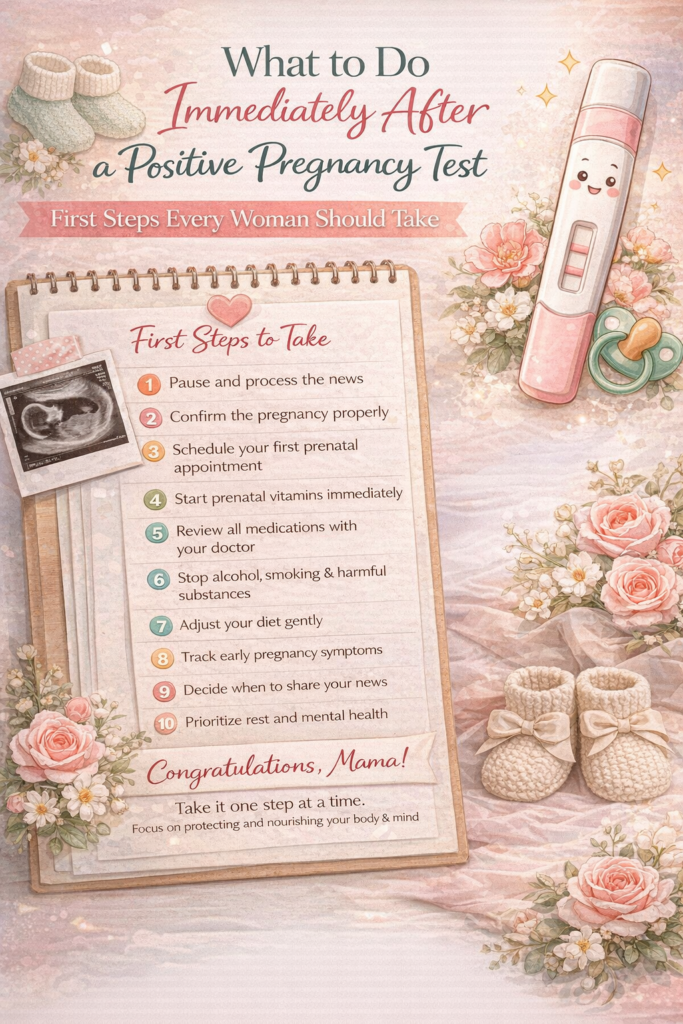
This guide will walk you through exactly what to do immediately after a positive pregnancy test, step by step — medically, emotionally, and practically.
Let’s move forward calmly and clearly.
Step 1: Pause and Process the News
Before making phone calls or Googling symptoms, take a moment.
Sit down.
Breathe deeply.
Let the reality settle.
Even if you were trying to conceive, the confirmation can feel surreal. Hormones begin shifting very early, which can amplify emotions.
There is no “correct” reaction. Your feelings are valid.
Step 2: Confirm the Pregnancy Properly
Home pregnancy tests detect the hormone hCG (human chorionic gonadotropin) in urine. When used correctly after a missed period, they are about 99% accurate.
If you want confirmation:
- Repeat the test in 48 hours (hCG doubles every 48–72 hours)
- Use first-morning urine for strongest concentration
- Book a blood test (β-hCG) through your doctor if needed
If the second line is faint — it still indicates pregnancy.
When to Seek Urgent Care
Contact a doctor immediately if you experience:
- Severe lower abdominal pain
- Shoulder pain
- Heavy bleeding
- Fainting or dizziness
These could indicate an ectopic pregnancy, which requires urgent medical attention.
Step 3: Schedule Your First Prenatal Appointment
One of the most important things to do after a positive pregnancy test is to schedule your first prenatal visit.
Most first appointments happen at 6–8 weeks of pregnancy (counted from the first day of your last period).
During this visit, your healthcare provider will:
- Confirm the pregnancy with ultrasound or blood tests
- Estimate your due date
- Review your medical history
- Assess risk factors
- Discuss prenatal screening tests
- Advise on nutrition and supplements
If you have a history of miscarriage, chronic illness, or fertility treatment, your doctor may see you earlier.
Step 4: Start Prenatal Vitamins Immediately
If you’re not already taking prenatal vitamins, start now.
Why This Is Urgent
The baby’s neural tube (which becomes the brain and spinal cord) forms within the first 4 weeks — often before a woman even knows she is pregnant.
The most critical nutrient is:
Folic Acid (400–800 mcg daily)
This reduces the risk of neural tube defects.
Other important nutrients:
- Iron (supports increased blood volume)
- Calcium (bone development)
- Vitamin D (immune and bone health)
- DHA (brain development)
Do not take high-dose supplements without medical advice.
Step 5: Review All Medications and Supplements
Immediately inform your doctor about:
- Prescription medications
- Over-the-counter drugs
- Herbal remedies
- Weight loss supplements
- Acne treatments
- Anxiety or depression medications
Some medications are not safe in pregnancy, but do not stop essential prescriptions suddenly without medical supervision.
Your doctor will guide you safely.
Step 6: Stop Alcohol, Smoking & Harmful Substances
There is no safe level of alcohol in pregnancy.
If you smoke or use recreational drugs, stopping now significantly improves pregnancy outcomes.
Limit caffeine intake to:
Maximum 200 mg per day
(about one small cup of coffee)
If you had alcohol before knowing you were pregnant, do not panic. Simply stop now and inform your doctor at your first visit.
Step 7: Adjust Your Diet Gently and Intentionally
You do not need a dramatic diet overhaul, but you should begin eating with pregnancy safety in mind.
Focus On:
- Lean proteins (eggs, chicken, legumes)
- Whole grains
- Fresh fruits and vegetables
- Adequate hydration (2–3 liters daily)
Avoid:
- Raw or undercooked meat
- Unpasteurized dairy
- High-mercury fish (shark, swordfish)
- Raw eggs
- Excess processed food
Small, frequent meals can help if nausea begins.
Step 8: Understand How Pregnancy Weeks Are Counted
Many women are confused at this stage.
Pregnancy is calculated from:
The first day of your last menstrual period (LMP)
This means:
When you test positive, you may already be 4–5 weeks pregnant, even though conception occurred about 2 weeks after your period.
This is normal and standard in obstetrics.
Step 9: Track Early Pregnancy Symptoms
Common early pregnancy symptoms include:
- Missed period
- Nausea (morning sickness)
- Fatigue
- Breast tenderness
- Frequent urination
- Mild cramping
- Light spotting
Mild cramping can be normal due to uterine expansion.
However, heavy bleeding or severe pain is not normal.
Avoid excessive internet searches. They often increase anxiety unnecessarily.
Step 10: Prioritize Rest and Energy Conservation
Early pregnancy fatigue can feel intense.
Your body is:
- Increasing blood volume
- Building the placenta
- Producing pregnancy hormones
- Supporting cellular development
It is biologically demanding.
If you feel tired:
- Nap if possible
- Go to bed earlier
- Reduce non-essential stress
Fatigue is not weakness. It is biology.
Step 11: Decide When to Share the News
This decision is personal.
Some women tell:
- Their partner immediately
- Close family right away
- No one until after the first trimester
The first trimester carries a higher miscarriage risk (about 10–20% of known pregnancies), which is why some couples choose to wait.
Choose what feels emotionally safe.
Step 12: Protect Your Mental Health
Hormones like progesterone and estrogen rise quickly, affecting mood.
You may experience:
- Emotional sensitivity
- Anxiety
- Irritability
- Crying easily
This is common.
Practical steps:
- Talk to someone you trust
- Avoid overwhelming online forums
- Journal your thoughts
- Practice gentle breathing exercises
If anxiety becomes intense or persistent, seek professional help.
Step 13: Begin Light Physical Activity (If Safe)
If you were active before pregnancy, you can usually continue:
- Walking
- Prenatal yoga
- Light strength training
- Swimming
Avoid:
- High-impact sports
- Heavy lifting
- Activities with fall risk
Always confirm with your healthcare provider.
Step 14: Understand What NOT to Do Immediately
After a positive pregnancy test, avoid:
- Panic shopping baby items
- Extreme diet changes
- Drastic workout routines
- Reading horror stories online
- Comparing your journey to others
Pregnancy is gradual.
Right now, your job is simple:
Protect. Nourish. Confirm. Rest.
Step 15: Plan Financial and Practical Discussions
You do not need immediate financial planning, but it’s wise to begin discussing:
- Maternity leave policies
- Health insurance coverage
- Savings plans
- Support systems
This can wait until after your first appointment if you feel overwhelmed.
Step 16: Recognize That Early Pregnancy Is Fragile, But Not Helpless
It’s important to understand something clearly:
Most early miscarriages happen due to chromosomal abnormalities — not because of something the mother did.
Lifting groceries, mild stress, or walking does not cause miscarriage.
Focus on controllable factors:
- Avoid harmful substances
- Take prenatal vitamins
- Attend medical appointments
Release guilt about everything else.
Step 17: Calculate an Estimated Due Date
Your estimated due date (EDD) is typically:
40 weeks from the first day of your last menstrual period
Your doctor may adjust this based on early ultrasound measurements.
Remember: Only about 5% of babies are born exactly on their due date.
It is an estimate — not a deadline.
Step 18: Begin Learning, But Gradually
Pregnancy information can feel overwhelming.
Instead of consuming everything at once, start with:
- First trimester basics
- Nutrition guidance
- Safe exercise
- Emotional health
Structured learning reduces anxiety.
A Gentle Reminder
A positive pregnancy test marks the beginning not perfection.
You do not have to become the “ideal mother” overnight.
You only need to take the next right step.
Motherhood begins slowly with awareness, care, and courage.