
When you’re trying to get pregnant, every small detail can feel important. You track ovulation, adjust your diet, monitor symptoms — and then a question pops up at 2 a.m.:
Does my sleeping position affect my chances of getting pregnant?
You may have heard that sleeping on your back helps sperm “stay in place,” or that certain positions increase fertility. But is there real science behind these claims?
In this guide, we’ll explore:
- Whether sleeping position affects conception
- The role of gravity after intercourse
- What actually improves your chances of pregnancy
- Best sleep practices for hormonal balance
- Myths vs. medical facts
- When to focus on bigger fertility factors
Let’s separate fertility facts from fiction.
Does Sleeping Position Affect Your Chances of Getting Pregnant?
Short answer:
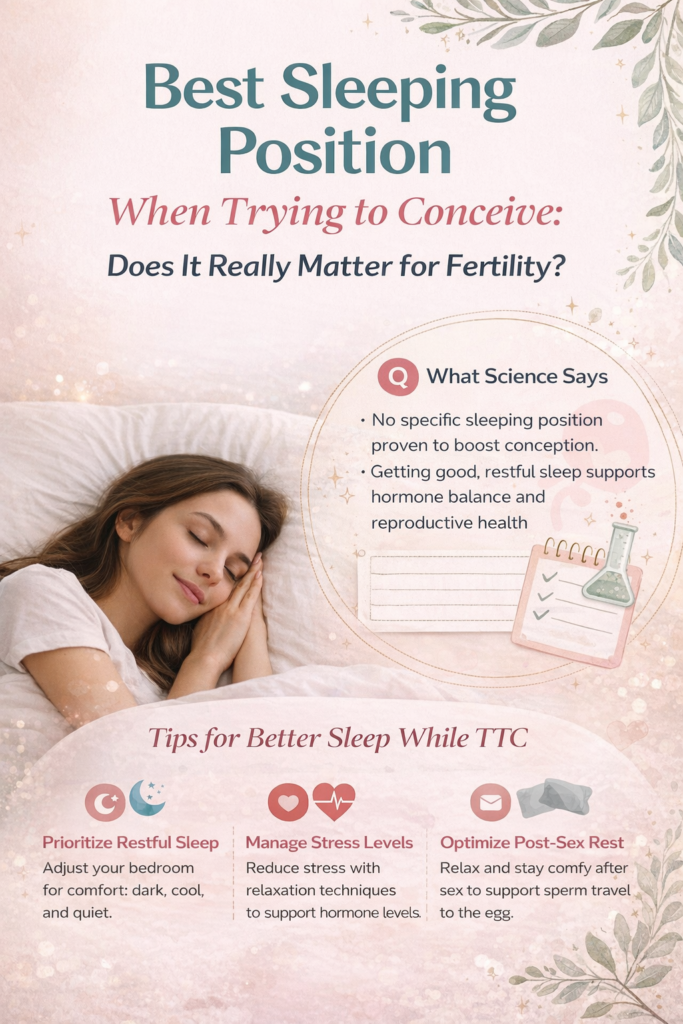
No strong scientific evidence shows that sleeping position directly impacts conception.
Pregnancy occurs when:
- Sperm travels through the cervix
- Reaches the fallopian tube
- Fertilizes an egg
- The embryo implants in the uterus
What Happens to Sperm After Intercourse?
Understanding this process helps eliminate common concerns.
After ejaculation:
- Sperm enters the vagina.
- The fastest sperm reach the cervix within minutes.
- Cervical mucus (especially during ovulation) helps guide sperm upward.
- Fertilization typically occurs in the fallopian tube within 12–24 hours of ovulation.
Gravity plays a minimal role because sperm are biologically programmed to swim.
Even if some semen leaks out afterward (which is normal), the sperm needed for fertilization have already begun their journey.
Is It Helpful to Lie Down After Sex?
While sleeping position doesn’t matter long-term, lying down for 10–15 minutes after intercourse may be mildly beneficial — especially during the fertile window.
Some small studies suggest that remaining horizontal briefly may increase sperm exposure to the cervix.
However:
- You do not need to elevate your legs.
- You do not need to stay upside down.
- You do not need to remain still for hours.
Simple rest is sufficient.
Best Sleeping Position for Fertility: What Actually Helps
Even though sleep posture doesn’t directly influence sperm transport, sleep quality absolutely affects fertility.
Hormonal balance depends heavily on circadian rhythm and restorative sleep.
Here’s how to optimize sleep when trying to conceive:
1. Sleep on Your Back or Side — For Comfort
There’s no fertility advantage of back vs side sleeping when trying to conceive.
Choose the position that allows:
- Deep sleep
- Minimal waking
- Reduced stress
Chronic poor sleep can disrupt reproductive hormones like:
- Estrogen
- Progesterone
- Testosterone
- Luteinizing hormone (LH)
2. Prioritize 7–9 Hours of Sleep
Sleep deprivation may:
- Disrupt ovulation
- Reduce sperm quality
- Increase stress hormones
- Interfere with menstrual regularity
Consistent sleep supports reproductive hormone regulation.
3. Reduce Nighttime Stress
Trying to conceive can create anxiety that affects sleep.
Chronic stress increases cortisol, which can interfere with:
- Ovulation
- Testosterone production
- Libido
Relaxation techniques before bed help improve hormonal balance.
Common Fertility Sleep Myths
Myth #1: Sleeping on Your Back Keeps Sperm From Leaking Out
Reality:
Sperm begins moving toward the cervix almost immediately. Semen leakage afterward does not reduce pregnancy chances.
Myth #2: Elevating Your Hips All Night Improves Conception
Reality:
No scientific evidence supports prolonged elevation.
Briefly lying down is enough.
Myth #3: Sleeping on Your Stomach Reduces Fertility
Reality:
There’s no evidence that stomach sleeping interferes with conception.
Myth #4: Certain “Fertility Positions” in Bed Increase Pregnancy Odds
Reality:
Sleep posture after intercourse has negligible impact on conception success.
Timing intercourse around ovulation matters far more.
What Actually Increases Your Chances of Getting Pregnant
1. Timing Intercourse Correctly
Have sex:
- Every 2–3 days
- Daily or every other day during the fertile window
The day before ovulation is statistically optimal.
2. Tracking Ovulation
Use:
- Ovulation predictor kits
- Basal body temperature
- Cervical mucus monitoring
Precision improves probability.
3. Supporting Hormonal Health
Maintain:
- Balanced diet
- Healthy weight
- Moderate exercise
- Low stress
- Adequate sleep
4. Supporting Male Fertility
Optimize:
- Sperm count
- Motility
- Avoid heat exposure
- Avoid smoking
- Limit alcohol
Conception is a shared biological process.
Can Poor Sleep Reduce Fertility?
Yes — indirectly.
Chronic poor sleep may:
- Disrupt ovulation cycles
- Lower testosterone levels
- Increase insulin resistance
- Affect thyroid hormones
- Increase inflammation
Shift workers, for example, sometimes experience menstrual irregularities due to circadian disruption.
Improving sleep quality can help regulate reproductive hormones.
Ideal Night Routine When Trying to Conceive
Here’s a fertility-friendly sleep strategy:
- Go to bed at consistent time
- Limit screen exposure 60 minutes before bed
- Avoid caffeine after early afternoon
- Keep bedroom cool and dark
- Practice stress-reduction techniques
Hormones thrive on routine.
Does Sleep Position Matter After Embryo Implantation?
Once implantation occurs:
Sleeping position still does not affect embryo attachment.
The uterus is a muscular organ that protects and supports the developing pregnancy regardless of posture.
When to See a Doctor
If pregnancy hasn’t occurred after:
- 12 months (under 35)
- 6 months (35 and older)
Seek evaluation.
Focus should be on:
- Ovulation confirmation
- Semen analysis
- Hormonal testing
- Fallopian tube patency
Sleeping position is not considered a clinical infertility factor.
Emotional Reassurance: You Don’t Need to Over-Control Everything
Trying to conceive can make you hyper-aware of small behaviors.
It’s natural to wonder whether sleep posture might help.
But fertility success depends primarily on:
- Ovulation timing
- Sperm health
- Hormone balance
- Reproductive anatomy
- Age
Not sleeping angle.
Let yourself rest comfortably without fear of “doing it wrong.”
What’s the Best Sleeping Position When Trying to Conceive?
There is no scientifically proven “best” sleeping position for getting pregnant.
What truly matters:
✔ Have intercourse during the fertile window
✔ Lie down briefly afterward if desired
✔ Get 7–9 hours of quality sleep
✔ Reduce stress
✔ Maintain overall reproductive health
Sleep position is far less important than sleep quality.