
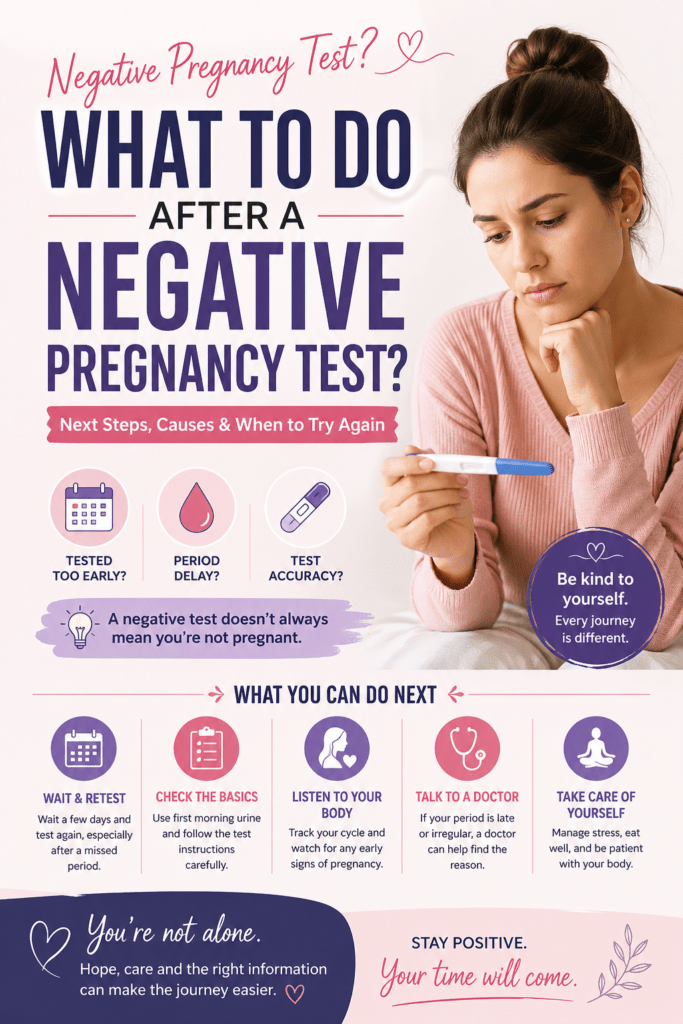
Seeing a negative pregnancy test can feel like a quiet heartbreak, especially if you were hoping for a different result.
You may be asking yourself:
- Did I test too early?
- Could the result be wrong?
- Why do I feel pregnant but the test is negative?
- When should I try again?
First, take a breath.
A negative pregnancy test does not always mean “never.” Often, it simply means “not yet” or “too soon.”
In this guide, we’ll break down:
- Why pregnancy tests show negative results
- When to retest
- What could delay a positive result
- When to see a doctor
- How to cope emotionally
Let’s walk through this step by step.
How Pregnancy Tests Work
Pregnancy tests detect the hormone hCG (human chorionic gonadotropin) in your urine.
This hormone:
- Is produced after implantation
- Rises rapidly in early pregnancy
- Doubles roughly every 48–72 hours
If hCG levels are too low when you test, the result may be negative — even if you are actually pregnant.
This is the most common reason for a negative pregnancy test.
7 Common Reasons for a Negative Pregnancy Test
- You Tested Too Early
This is the #1 cause.
If you test before implantation occurs or before hCG rises high enough, the test cannot detect pregnancy.
Best practice:
- Wait until at least the first day of your missed period.
- For higher accuracy, wait 2–3 days after a missed period.
- Late Ovulation
Many women assume they ovulate on day 14.
But ovulation can shift due to:
- Stress
- Travel
- Illness
- Hormonal fluctuations
If ovulation happened later than expected, implantation and hCG production also happen later.
This delays a positive test.
- Diluted Urine
Testing later in the day after drinking a lot of fluids can dilute hCG levels.
For best accuracy:
- Use first-morning urine.
- Avoid excessive water before testing.
- Testing Error
Possible issues include:
- Expired test
- Incorrect usage
- Reading results outside recommended time window
Always follow instructions carefully.
- Chemical Pregnancy (Very Early Loss)
A chemical pregnancy is a very early miscarriage that occurs shortly after implantation.
You may experience:
- A faint positive followed by negative
- Slightly delayed period
- Heavier-than-usual bleeding
These are common and often due to chromosomal abnormalities.
They are rarely caused by something you did.
- Irregular Periods
If your cycles vary, predicting ovulation can be inaccurate.
This may lead to mistimed testing.
Tracking ovulation signs is more reliable than calendar counting alone.
- Medical Conditions
Certain conditions can affect ovulation or hormone levels, including:
- Polycystic Ovary Syndrome (PCOS)
- Thyroid disorders
- High prolactin levels
If negative tests continue month after month, medical evaluation may be helpful.
When Should You Retest?
If your test is negative but your period hasn’t started:
- Wait 48–72 hours.
- Retest using first-morning urine.
- Avoid over-testing daily — it increases stress.
If your period is more than 7 days late and tests remain negative, contact your doctor.
Negative Pregnancy Test but No Period — What Does It Mean?
This situation is common.
Possible causes:
- Delayed ovulation
- Stress
- Hormonal imbalance
- Recent illness
- Travel or sleep disruption
Your body does not run on a perfect schedule every month.
Even healthy cycles can shift occasionally.
Can a Pregnancy Test Be Wrong?
False negatives are more common than false positives.
A false negative may occur if:
- You test too early
- hCG is too low
- Urine is diluted
False positives are rare but can happen due to:
- Chemical pregnancy
- Certain medications (hCG injections)
- Rare medical conditions
If unsure, a blood test (β-hCG) provides more accurate results.
How Long Should You Try Before Seeing a Doctor?
Guidelines generally recommend:
- Under age 35 → Seek help after 12 months of trying
- Over age 35 → Seek help after 6 months
- Over age 40 → Consider evaluation sooner
See a doctor earlier if you have:
- Irregular cycles
- Painful periods
- Known reproductive conditions
- Previous miscarriages
Early testing can identify treatable issues.
Emotional Impact of a Negative Pregnancy Test
This part is often underestimated.
Trying to conceive can create a monthly emotional cycle:
- Hope during ovulation
- Waiting during the two-week wait
- Anxiety before testing
- Disappointment with a negative result
You may feel:
- Sadness
- Frustration
- Self-doubt
- Anger
- Envy of others’ pregnancies
All of these feelings are valid.
Allow yourself to feel them without judgment.
How to Cope After a Negative Pregnancy Test
- Take a Short Emotional Pause
It’s okay to step back for a day or two.
- Talk to Your Partner
Fertility is a shared journey.
- Avoid Comparison
Everyone’s timeline is different.
- Focus on What You Can Control
- Track ovulation more accurately
- Improve nutrition
- Sleep better
- Reduce stress
- Consider a Break If Needed
Sometimes one relaxed cycle reduces pressure.
Practical Next Steps
After a negative pregnancy test:
- Confirm ovulation timing.
- Track cervical mucus.
- Use ovulation predictor kits next cycle.
- Have intercourse 2–3 days before ovulation.
- Maintain healthy habits.
Small adjustments can make a big difference.
Signs You May Still Be Pregnant (Despite a Negative Test)
Sometimes symptoms appear before tests turn positive:
- Breast tenderness
- Nausea
- Fatigue
- Light cramping
- Implantation spotting
If symptoms persist and your period does not arrive, retest after a few days.
Important Perspective: One Cycle Does Not Define Fertility
Even with perfect timing:
- Healthy couples have only about 20–25% chance per cycle.
- Most couples conceive within one year.
A negative test is not a diagnosis of infertility.
It’s simply one data point in a longer journey.
Final Encouragement
A negative pregnancy test can feel heavy — but it is not the end of your story.
Sometimes it means:
- You tested too early.
- Ovulation shifted.
- Your timing needs adjustment.
Sometimes it simply means:
Not this month.
Be gentle with yourself.
Your body is not failing you.
Conception is biology + timing + probability.
Stay informed. Stay patient. Stay hopeful.