
Trying to conceive can begin with excitement and hope. But when months pass without a positive pregnancy test, it’s natural to start wondering:
- Is something wrong?
- Are we waiting too long?
- When should we see a fertility specialist?
Here’s the reassuring truth:
Needing fertility support is more common than many people realize. Seeking help is not a sign of failure, it’s a proactive step toward understanding your body and improving your chances of pregnancy.
Let’s break down exactly when to see a fertility specialist, what warning signs to look for, and what happens next.
How Long Should You Try Before Seeking Help?
Medical guidelines generally recommend:
Under Age 35
- Try for 12 months of regular, unprotected intercourse before seeking evaluation.
Age 35–39
- Seek help after 6 months of trying.
Age 40 and Above
- Consider seeing a fertility specialist sooner — even after a few months of trying.
Why the difference?
Because female fertility declines with age, especially after 35. Early evaluation can save valuable time.
What Counts as “Regular Trying”?
To optimize chances:
- Have intercourse every 1–2 days during your fertile window.
- Focus especially on the 2–3 days before ovulation.
- Avoid relying only on calendar apps without ovulation tracking.
If timing has not been optimized, adjusting strategy may be the first step before specialist referral.
Signs You Should See a Fertility Specialist Sooner
You do not need to wait the full 6–12 months if certain factors apply.
- Irregular or Absent Periods
Irregular cycles may indicate:
- Polycystic Ovary Syndrome (PCOS)
- Thyroid disorders
- Ovulation problems
- Hormonal imbalance
If your cycles are:
- Longer than 35 days
- Shorter than 21 days
- Highly unpredictable
- Completely absent
Consult a doctor earlier.
- Painful or Heavy Periods
Severe menstrual pain may suggest:
- Endometriosis
- Fibroids
- Adenomyosis
These conditions can affect fertility and benefit from early treatment.
- Recurrent Miscarriages
If you’ve experienced:
- Two or more pregnancy losses
A fertility specialist can evaluate for:
- Hormonal issues
- Genetic factors
- Uterine abnormalities
- Autoimmune conditions
- Known Reproductive Conditions
Seek early help if you have:
- PCOS
- Endometriosis
- Blocked fallopian tubes
- History of pelvic infections
- Previous ovarian surgery
Early intervention improves outcomes.
- Male Factor Concerns
Fertility is not only a female issue.
Male factors account for approximately 40–50% of infertility cases.
Consult sooner if:
- Known low sperm count
- Erectile dysfunction
- History of testicular surgery
- Varicocele
- Chemotherapy history
A semen analysis is simple and informative.
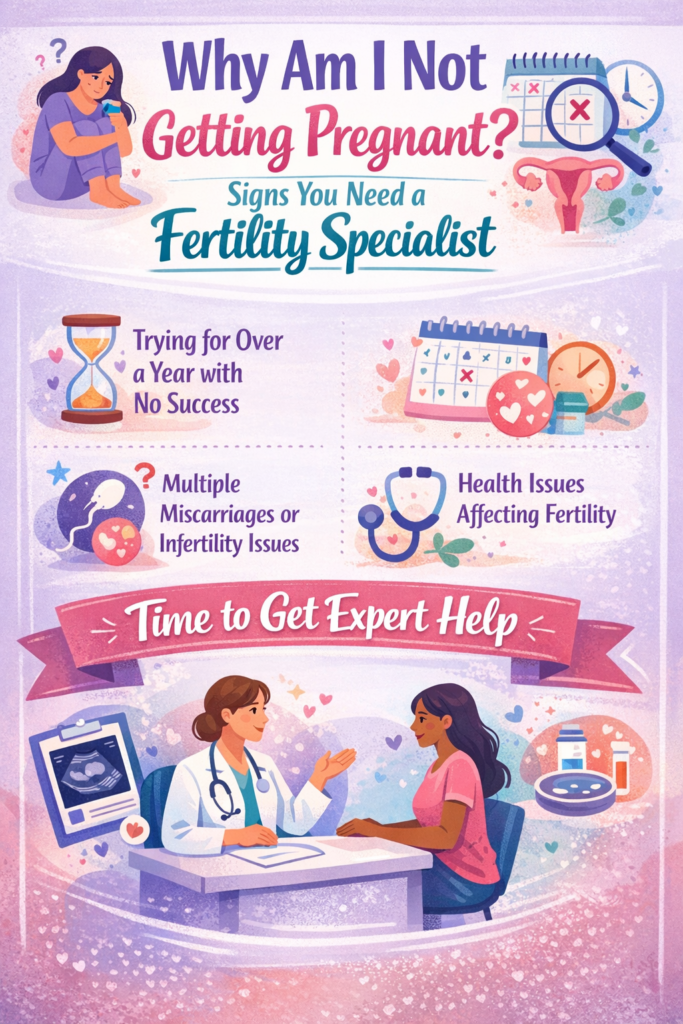
Who Is a Fertility Specialist?
A fertility specialist is typically a Reproductive Endocrinologist — a doctor trained in:
- Hormonal disorders
- Ovulation issues
- Assisted reproductive technologies (ART)
- In vitro fertilization (IVF)
They focus specifically on conception challenges.
What Happens at Your First Fertility Appointment?
Knowing what to expect reduces anxiety.
Your first visit may include:
- Detailed Medical History
- Cycle length
- Pregnancy history
- Sexual frequency
- Lifestyle factors
- Hormone Testing
Blood tests may check:
- FSH
- LH
- AMH
- Thyroid function
- Prolactin
- Ultrasound
To evaluate:
- Ovarian follicles
- Uterine lining
- Structural abnormalities
- Semen Analysis
To assess sperm count, motility, and morphology.
- Fallopian Tube Testing (If Needed)
A procedure called HSG (hysterosalpingogram) checks for blocked tubes.
Not all tests are done at once. The approach is personalized.
Common Fertility Treatments (If Needed)
Treatment depends on the cause.
Options may include:
- Ovulation induction medications
- Timed intercourse
- Intrauterine insemination (IUI)
- In vitro fertilization (IVF)
- Lifestyle modifications
Not everyone needs IVF. Many couples conceive with simple adjustments.
Can Lifestyle Changes Improve Fertility Before Seeing a Specialist?
Yes — and sometimes they make a big difference.
For Women:
- Maintain healthy weight
- Take folic acid (400–800 mcg daily)
- Manage stress
- Sleep 7–8 hours
- Limit alcohol
For Men:
- Avoid smoking
- Reduce alcohol
- Avoid excessive heat exposure
- Exercise moderately
Fertility reflects overall health.
Emotional Side of Seeking Fertility Help
Deciding to see a fertility specialist can feel heavy.
You may think:
- “I thought this would happen naturally.”
- “Are we broken?”
- “What if something is seriously wrong?”
But seeking help is strength.
Information reduces uncertainty. Early evaluation often brings reassurance — or solutions.
Many couples discover:
- Minor timing adjustments
- Treatable hormonal imbalances
- Mild male factor issues
And go on to conceive.
Myths About Seeing a Fertility Specialist
- It means IVF is your only option.
- It means you are infertile.
- It means something is seriously wrong.
In reality:
✔ It provides clarity.
✔ It saves time.
✔ It improves success rates.
Early consultation does not commit you to treatment. It gives you information.
Quick Summary: When to See a Fertility Specialist
You should consider evaluation if:
- Under 35 → Trying 12 months
- 35–39 → Trying 6 months
- 40+ → Consider sooner
- Irregular cycles
- Recurrent miscarriage
- Known reproductive issues
- Male factor concerns
Trust your instincts. If something feels off, seek guidance.
Final Encouragement
Trying to conceive is a journey filled with hope — but sometimes uncertainty.
Seeing a fertility specialist is not giving up.
It is moving forward with knowledge.
If you’ve been wondering whether it’s time, this may be your sign to have that conversation.
You deserve answers.
You deserve support.
And you deserve every possible chance at the family you’re dreaming of.