If you’re trying to conceive, you’re probably asking one important question:
When are the best days to get pregnant?
The answer isn’t random — and it’s not “any time during the month.” In fact, pregnancy can only happen during a small number of days each cycle. Missing that window, even by a couple of days, can significantly reduce your chances.
The good news? Once you understand your fertile window, your chances of getting pregnant increase dramatically.
In this complete guide, you’ll learn:
- What the fertile window really is
- The exact best days to have intercourse
- How to calculate ovulation (even with irregular periods)
- Signs your body gives before ovulation
- Common mistakes couples make
- Practical tips to boost fertility naturally
Let’s make conception less confusing — and more strategic.
Understanding Your Menstrual Cycle
Before identifying the best days to get pregnant, you must understand how your menstrual cycle works.
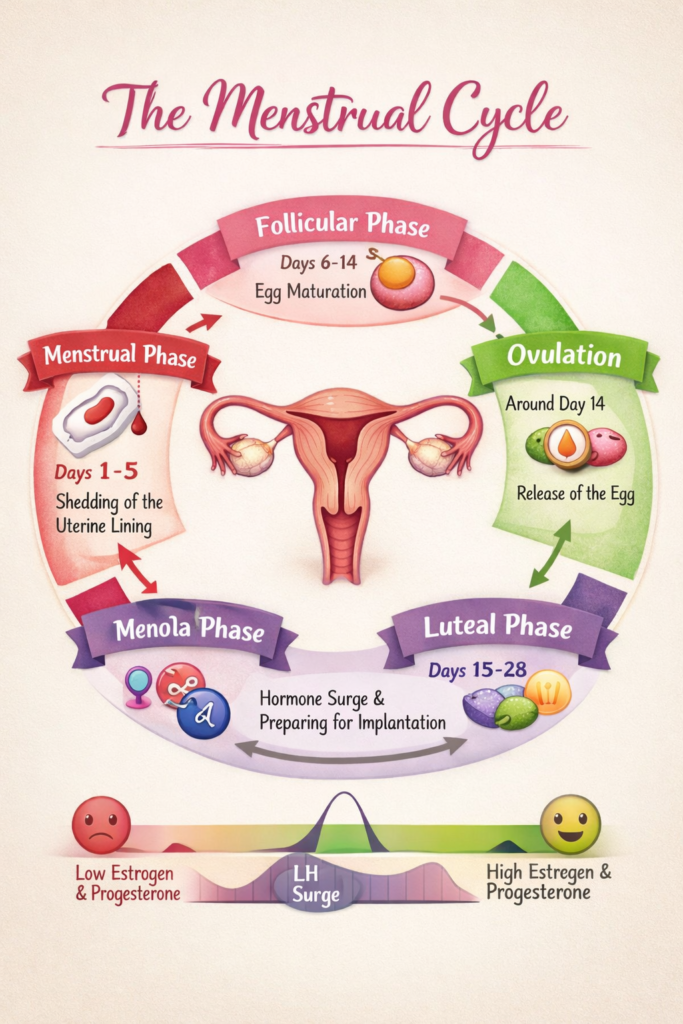
A typical cycle has four phases:
- Menstrual Phase – Your period
- Follicular Phase – Egg matures
- Ovulation – Egg is released
- Luteal Phase – Body prepares for pregnancy
Ovulation is the key event.
Ovulation happens when one ovary releases a mature egg. This egg survives for only 12 to 24 hours.
That means conception is possible only during a short time each month.
What Is the Fertile Window?
Your fertile window includes:
- The 5 days before ovulation
- The day of ovulation
Why five days before?
Because sperm can live inside the female reproductive tract for up to 5 days under optimal conditions.
So if you have intercourse a few days before ovulation, sperm can wait for the egg.
The Absolute Best Days to Get Pregnant:
- 3 days before ovulation
- 2 days before ovulation
- 1 day before ovulation (highest probability)
- Ovulation day
Research shows that the day before ovulation gives the highest pregnancy rate.
Timing matters more than frequency.
How to Calculate Ovulation
Ovulation does NOT always happen on day 14.
A common mistake is assuming every woman has a 28-day cycle.
Instead, ovulation usually occurs:
About 14 days before your next period begins.
Examples:
- 28-day cycle → Ovulation around day 14
- 30-day cycle → Ovulation around day 16
- 26-day cycle → Ovulation around day 12
- 32-day cycle → Ovulation around day 18
The key formula:
Cycle length – 14 days = Approximate ovulation day
Track at least 2–3 cycles to understand your pattern. The more data you collect, the more accurate your predictions become.
But calendar tracking alone isn’t enough — especially if your cycles vary even slightly.
That’s where body signals become powerful.
5 Clear Signs You’re About to Ovulate
If you’re trying to identify the best days to get pregnant, learning to recognize ovulation signs can dramatically improve timing.
- Egg-White Cervical Mucus (Most Reliable Natural Sign)
As ovulation approaches, vaginal discharge becomes:
- Clear
- Slippery
- Stretchy
- Similar to raw egg whites
This type of cervical mucus helps sperm swim easily toward the egg.
When you see this — you are in your fertile window.
- Positive Ovulation Predictor Kit (OPK)
Ovulation tests detect the LH surge (Luteinizing Hormone).
A positive result means:
Ovulation is likely within 24–36 hours.
This is the ideal time to have intercourse.
For best results:
- Start testing 3–4 days before expected ovulation.
- Test at the same time daily.
- Avoid excessive fluids beforehand.
- Mild One-Sided Pelvic Pain (Mittelschmerz)
Some women feel a slight cramp or twinge on one side of the lower abdomen.
This can indicate ovulation is occurring.
Not everyone feels it — but if you do, it’s a helpful sign.
- Increased Libido
Hormones naturally increase sexual desire during fertile days.
Your body biologically encourages reproduction.
- Basal Body Temperature (BBT) Rise
After ovulation, body temperature rises slightly (about 0.3–0.5°C).
BBT confirms ovulation after it happens, which helps predict future cycles.
How Often Should You Have Intercourse to Get Pregnant?
One of the most common questions.
For maximum chances:
- Have intercourse every 1–2 days during your fertile window.
- Focus especially on the 2 days before ovulation.
Daily intercourse is safe for healthy couples and does NOT “drain sperm.”
If sperm quality is a concern, every other day may be recommended.
Consistency > perfection.
What If You Have Irregular Periods?
Irregular cycles make predicting ovulation harder — but not impossible.
You may ovulate at different times each month.
Helpful tools include:
- Ovulation predictor kits
- Cervical mucus tracking
- Basal body temperature charting
- Fertility tracking apps
If your cycles are extremely irregular (e.g., longer than 35 days or shorter than 21 days), consult a doctor.
Conditions like:
- PCOS
- Thyroid disorders
- Hormonal imbalances
can affect ovulation.

Can You Get Pregnant Right After Your Period?
It depends on various factors.
If you have:
- Short cycles (21–24 days)
- Early ovulation
Then yes — pregnancy is possible soon after your period.
Sperm can survive up to 5 days.
This means intercourse shortly after menstruation can still result in pregnancy if ovulation happens early.
Cycle length matters more than calendar assumptions.
Can You Get Pregnant During Ovulation Only?
Technically, yes — but the fertile window includes days BEFORE ovulation too.
If you wait until ovulation day only, you may miss the optimal timing.
The egg lives only 12–24 hours.
Sperm waiting in advance increases your chances significantly.
How Long Does It Usually Take to Get Pregnant?
Even with perfect timing:
- Healthy couples under 35 → 20–25% chance per cycle
- About 80–85% conceive within 12 months
- Women over 35 → slightly reduced monthly probability
Pregnancy is statistical — not instant.
One missed cycle does not mean infertility.
07 Common Mistakes Couples Make When Trying to Conceive
- Only trying on ovulation day
- Assuming every cycle is 28 days
- Not tracking ovulation signs
- High stress and performance pressure
- Using lubricants that harm sperm
- Giving up after 2–3 months
- Ignoring male fertility factors
Conception is a shared responsibility.
Do Certain Positions Increase Pregnancy Chances?
Scientifically, no sexual position guarantees pregnancy.
However:
- Deep penetration may deposit sperm closer to the cervix.
- Lying down for 10–15 minutes after intercourse may help sperm movement (though evidence is limited).
Gravity does not prevent pregnancy.
Sperm are biologically programmed to swim efficiently.
Lifestyle Factors That Improve Your Chances of Getting Pregnant
Fertility health goes beyond timing.
For Women:
- Maintain a healthy BMI
- Take folic acid (400–800 mcg daily)
- Reduce alcohol intake
- Stop smoking
- Sleep 7–8 hours
- Manage stress
For Men:
- Avoid smoking
- Limit alcohol
- Avoid excessive heat (hot tubs, laptops on lap)
- Maintain healthy weight
- Exercise moderately
Male sperm health directly impacts conception rates.
When Should You See a Fertility Specialist?
Consult a doctor if:
- Under 35 and trying for 12 months without success
- Over 35 and trying for 6 months
- Irregular or absent periods
- Painful periods
- Known reproductive conditions
- Previous miscarriages
Early evaluation can identify treatable causes.
Emotional Reality of Trying to Conceive
Trying to conceive can feel like a monthly emotional rollercoaster:
- Hope during ovulation
- Waiting during the two-week wait
- Anxiety before testing
- Disappointment if negative
This is normal.
Balance planning with mental well-being.
Over-monitoring can increase stress hormones, which may influence ovulation.
Gentle consistency works better than pressure.