Trying to conceive can be an exciting journey, but for some women, pregnancy doesn’t happen as quickly as expected. If you’ve been trying to get pregnant without success, fertility testing can provide valuable insights into your reproductive health and help identify potential obstacles to conception.
Many women feel anxious when they hear the words “fertility testing,” but these tests are designed to provide answers, not create fear. Modern fertility testing can help doctors understand ovulation patterns, egg reserve, hormone levels, uterine health, and fallopian tube function, allowing them to recommend the most effective treatment options.
In this comprehensive guide, you’ll learn everything you need to know about fertility testing for women, including when testing is recommended, the most common fertility tests, what the results mean, and how fertility testing can help you move closer to your dream of becoming a parent.
What Is Fertility Testing?
Fertility testing is a series of medical evaluations used to assess a woman’s reproductive health and ability to conceive.
These tests help determine:
- Whether ovulation is occurring regularly
- Egg quantity and ovarian reserve
- Hormone balance
- Uterine health
- Fallopian tube function
- Possible causes of infertility
Fertility testing can identify issues that may be preventing pregnancy and guide appropriate treatment plans.
When Should Women Consider Fertility Testing?
Not every couple needs fertility testing immediately.
Most healthcare providers recommend fertility evaluation if:
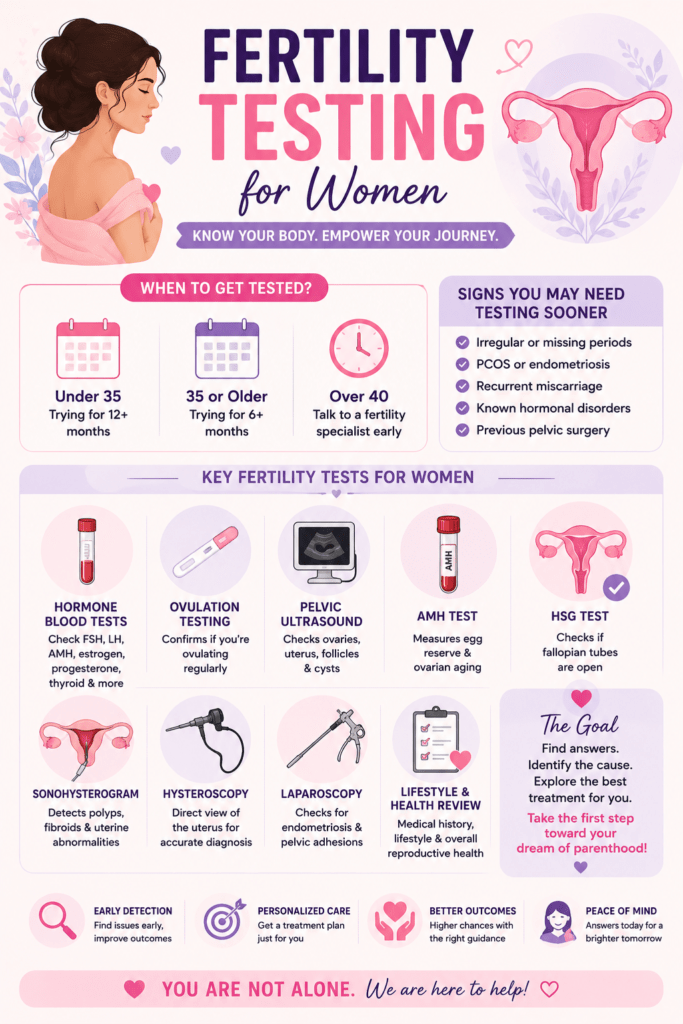
You’re Under 35
You have been trying to conceive for 12 months or longer without success.
You’re Over 35
You have been trying to conceive for 6 months without becoming pregnant.
You’re Over 40
You should consider speaking with a fertility specialist as soon as you begin trying to conceive.
Signs You May Need Fertility Testing Sooner
You may benefit from earlier fertility testing if you experience:
- Irregular periods
- Missing periods
- PCOS symptoms
- Endometriosis
- Recurrent miscarriages
- Pelvic inflammatory disease
- Previous pelvic surgery
- Known hormonal disorders
- Thyroid conditions
- Severe menstrual pain
Early evaluation can improve treatment outcomes and reduce delays.
Why Fertility Testing Is Important
Fertility challenges are more common than many people realize.
According to fertility experts, infertility affects millions of couples worldwide.
The good news is that many fertility issues can be identified and successfully treated.
Benefits of fertility testing include:
- Earlier diagnosis
- Personalized treatment plans
- Better pregnancy outcomes
- Reduced uncertainty
- Improved understanding of reproductive health
Knowledge is often the first step toward finding a solution.
Common Causes of Female Infertility
Before discussing fertility tests, it’s important to understand some common causes of infertility.
Ovulation Disorders
Conditions that prevent regular egg release.
Examples include:
- PCOS
- Thyroid disorders
- Hypothalamic dysfunction
Diminished Ovarian Reserve
A reduced number or quality of eggs.
Blocked Fallopian Tubes
Can prevent sperm and egg from meeting.
Endometriosis
Tissue similar to the uterine lining grows outside the uterus.
Uterine Abnormalities
Including:
- Fibroids
- Polyps
- Congenital abnormalities
Age-Related Fertility Decline
Female fertility naturally decreases with age, particularly after age 35.
What Happens During a Fertility Evaluation?
A fertility evaluation usually begins with a consultation.
Your doctor may ask about:
- Menstrual cycle history
- Previous pregnancies
- Lifestyle habits
- Medical conditions
- Medications
- Family history
- Sexual health history
This information helps guide further testing.
Hormone Blood Tests
Hormone testing is one of the most important parts of fertility evaluation.
These blood tests provide information about ovarian function and reproductive hormones.
Follicle-Stimulating Hormone (FSH)
FSH stimulates egg development.
Higher-than-normal levels may suggest reduced ovarian reserve.
Luteinizing Hormone (LH)
LH triggers ovulation.
Abnormal levels may indicate:
- PCOS
- Ovulation disorders
Estrogen (Estradiol)
Helps evaluate ovarian function and reproductive health.
Progesterone
Progesterone testing confirms whether ovulation has occurred.
Thyroid Hormone Testing
Thyroid disorders can significantly affect fertility.
Testing may include:
- TSH
- Free T4
Prolactin Testing
Elevated prolactin levels can interfere with ovulation.
AMH Test: Measuring Ovarian Reserve
One of the most common fertility tests today is the Anti-Müllerian Hormone (AMH) test.
AMH helps estimate:
- Remaining egg supply
- Ovarian reserve
- Response to fertility treatment
Why AMH Is Important
AMH does not predict your ability to become pregnant naturally, but it helps fertility specialists understand egg quantity.
Higher AMH generally indicates a larger ovarian reserve.
Ovulation Testing
Successful pregnancy requires regular ovulation.
Your doctor may recommend:
Ovulation Predictor Kits
Detect the LH surge before ovulation.
Blood Progesterone Testing
Confirms whether ovulation occurred.
Basal Body Temperature Tracking
Monitors subtle temperature changes after ovulation.
Ultrasound Monitoring
Tracks follicle development and egg release.
Pelvic Ultrasound
A pelvic ultrasound allows doctors to examine reproductive organs.
It can help identify:
- Ovarian cysts
- PCOS
- Uterine fibroids
- Endometrial abnormalities
- Follicle development
Ultrasounds are painless and commonly used during fertility evaluations.
Antral Follicle Count (AFC)
Antral follicles are small follicles visible on ultrasound.
Counting these follicles helps estimate ovarian reserve.
A higher follicle count generally suggests a better response to fertility treatments.
HSG Test (Hysterosalpingogram)
An HSG is a specialized X-ray that evaluates the uterus and fallopian tubes.
During the procedure:
- A contrast dye is injected into the uterus.
- X-ray images track the dye.
- Doctors check for blockages.
Why HSG Matters
Blocked fallopian tubes can prevent fertilization.
HSG is often one of the most important infertility tests.
Sonohysterogram (Saline Ultrasound)
This procedure involves placing sterile saline inside the uterus during an ultrasound.
It helps identify:
- Uterine polyps
- Fibroids
- Scar tissue
- Uterine abnormalities
Hysteroscopy
A hysteroscopy uses a small camera inserted through the cervix to examine the uterus directly.
Doctors may use it to diagnose and treat:
- Polyps
- Fibroids
- Adhesions
- Structural abnormalities
Laparoscopy for Fertility Evaluation
In certain cases, minimally invasive surgery may be recommended.
Laparoscopy can diagnose:
- Endometriosis
- Pelvic adhesions
- Tubal disease
It is usually reserved for situations where other tests suggest underlying problems.
Fertility Testing for PCOS
Women with PCOS often undergo additional testing.
Tests may include:
- Hormone panels
- Insulin resistance screening
- Ultrasound examination
- Ovulation tracking
Early diagnosis can improve fertility outcomes significantly.
Fertility Testing After Miscarriage
Women who experience recurrent pregnancy loss may require additional evaluation.
Testing may assess:
- Hormones
- Uterine structure
- Genetic factors
- Blood clotting disorders
Understanding the cause can help guide future pregnancy planning.
Can Fertility Testing Improve Pregnancy Chances?
Testing itself does not increase fertility.
However, identifying fertility problems allows doctors to recommend treatments that may improve conception chances.
Possible treatment options include:
- Lifestyle changes
- Ovulation medications
- IUI
- IVF
- Surgery when needed
How to Prepare for Fertility Testing
Before your appointment:
Keep Track of Your Menstrual Cycle
Record:
- Period dates
- Cycle length
- Ovulation signs
Bring Medical Records
Include:
- Previous test results
- Pregnancy history
- Medication lists
Prepare Questions
Write down concerns you want to discuss with your doctor.
Frequently Asked Questions
Is fertility testing painful?
Most fertility tests involve minimal discomfort. Procedures like HSG may cause temporary cramping.
Can fertility testing tell if I can get pregnant?
Testing can identify potential fertility issues but cannot guarantee pregnancy outcomes.
What is the most important fertility test for women?
There is no single most important test. Doctors often combine hormone testing, ultrasound evaluation, and ovulation assessment.
Does a normal fertility test guarantee pregnancy?
No. Fertility is complex, and even normal test results cannot guarantee conception.
At what age should I consider fertility testing?
Women over 35 who have been trying to conceive for six months should consider evaluation.
Final Thoughts
Fertility testing for women is a valuable tool for understanding reproductive health and identifying factors that may affect conception. Whether you’re struggling with irregular periods, PCOS, unexplained infertility, or simply want answers after months of trying to conceive, fertility testing can provide clarity and direction.
The sooner potential issues are identified, the sooner appropriate treatment options can be explored. Remember, fertility testing is not about finding problems—it’s about empowering you with information and helping you take the next step toward building the family you dream of.