If you’ve ever wondered:
- Why does my period come every month?
- What exactly is ovulation?
- Why do I feel different at different times of the month?
- How does my menstrual cycle affect pregnancy?
You’re not alone.
Understanding your menstrual cycle step-by-step is one of the most powerful things you can do for your health, whether you’re trying to conceive, avoiding pregnancy, or simply wanting to understand your body better.
Let’s break it down clearly, simply, and confidently.
What Is the Menstrual Cycle?
The menstrual cycle is your body’s monthly process of preparing for pregnancy.
It involves:
- Hormone changes
- Egg development
- Uterine lining growth
- Ovulation
- Period (if pregnancy doesn’t occur)
The average cycle length is 28 days, but normal cycles range from 21 to 35 days.
Day 1 of your cycle = The first day of your period.
The 4 Main Phases of the Menstrual Cycle
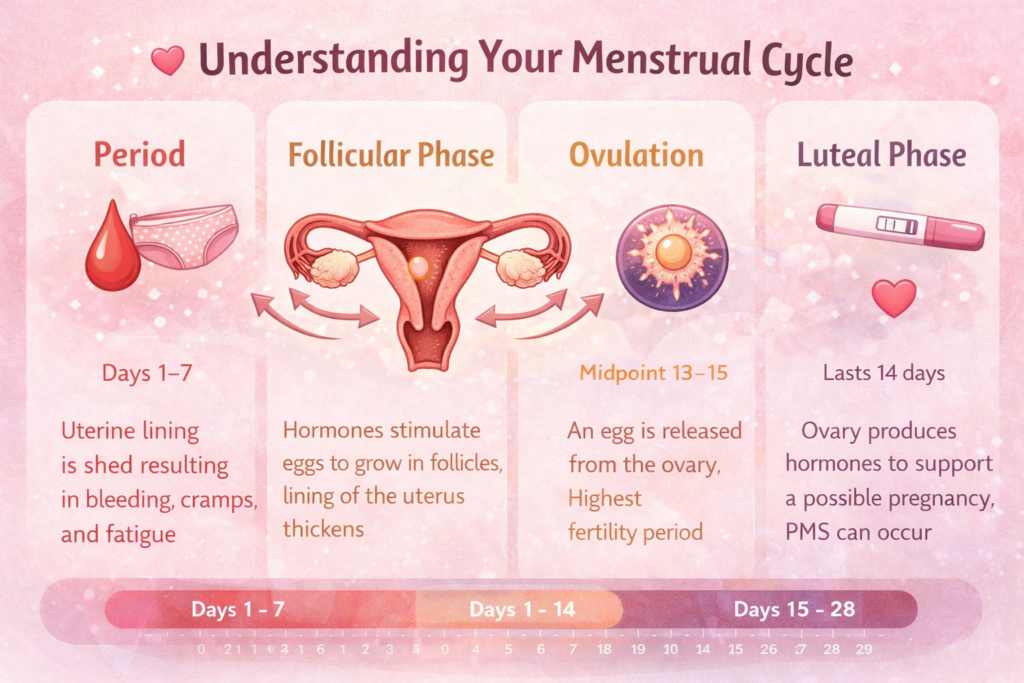
Your cycle has four main phases:
- Menstrual Phase
- Follicular Phase
- Ovulation Phase
- Luteal Phase
Let’s go step-by-step.
Phase 1: Menstrual Phase (Your Period)
What Happens?
If pregnancy did not occur in the previous cycle, your body sheds the uterine lining.
This shedding is your period.
It typically lasts:
- 3 to 7 days
What’s Happening Internally?
- Estrogen and progesterone levels drop.
- The thick uterine lining breaks down.
- Blood and tissue exit through the vagina.
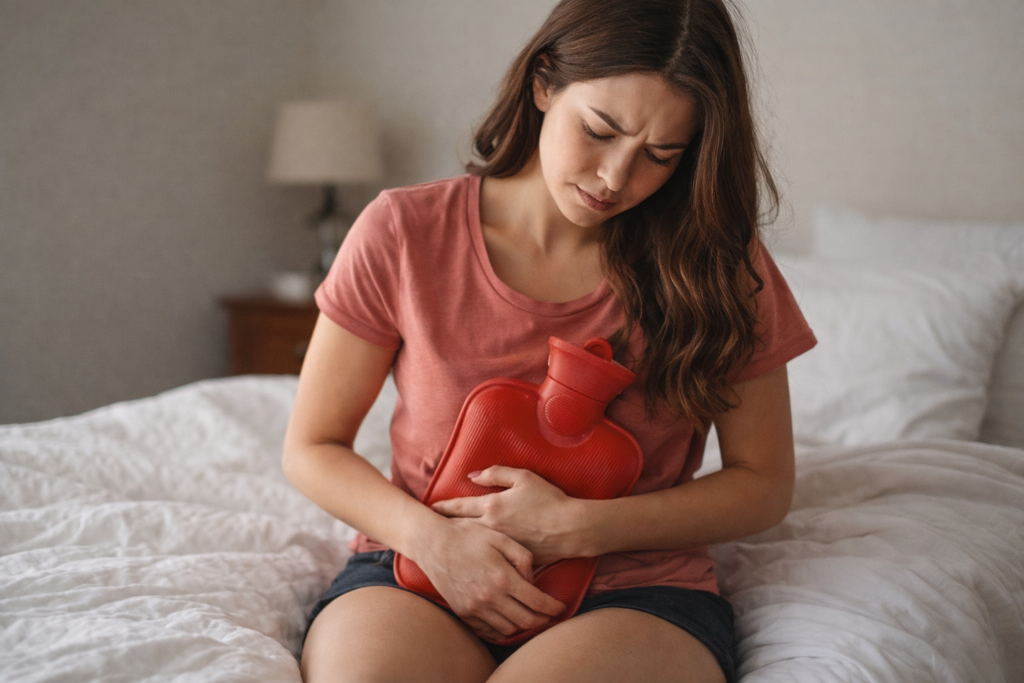
How You Might Feel
- Low energy
- Mild to moderate cramps
- Headaches
- Mood changes
- Back pain
This phase is often the lowest-energy part of the cycle.
Rest is important.
Phase 2: Follicular Phase (Preparation Phase)
The follicular phase begins on Day 1 of your period and continues until ovulation.
What Happens?
Your brain releases a hormone called FSH (Follicle-Stimulating Hormone).
This hormone tells your ovaries to prepare eggs.
Each ovary contains thousands of immature eggs. Several begin developing, but usually only one becomes dominant.
Meanwhile:
- Estrogen levels rise.
- The uterine lining begins rebuilding.
- Your body prepares for potential pregnancy.
How You Might Feel
As estrogen increases, you may notice:
- Improved mood
- More energy
- Clearer skin
- Higher motivation
- Increased focus
Many women feel their best during late follicular phase.
Phase 3: Ovulation (The Fertile Window)
Ovulation is the most important event in your cycle.
What Happens?
Around the middle of your cycle:
- Estrogen peaks.
- Your brain releases LH (Luteinizing Hormone).
- The ovary releases one mature egg.
This egg travels into the fallopian tube.
The egg survives for only 12–24 hours.
Why Ovulation Matters
Pregnancy can only happen during this window.
The fertile window includes:
- 5 days before ovulation
- Ovulation day
Because sperm can survive up to 5 days inside the body.
Ovulation Signs
You may notice:
- Clear, stretchy “egg white” discharge
- Mild one-sided pelvic pain
- Increased sex drive
- Slight increase in basal body temperature (after ovulation)
Phase 4: Luteal Phase (The Waiting Phase)
After ovulation, your body enters the luteal phase.
What Happens?
The follicle that released the egg becomes the corpus luteum.
It produces progesterone.
Progesterone:
- Maintains the uterine lining
- Prepares for implantation
- Supports early pregnancy if conception occurs
If the egg is fertilized:
- Pregnancy begins.
- Hormones stay elevated.
If not:
- Progesterone drops.
- The lining sheds.
- A new period starts.
How You Might Feel
Common luteal phase symptoms:
- Breast tenderness
- Bloating
- Mood swings
- Fatigue
- Food cravings
- PMS symptoms
This phase usually lasts 12–14 days.
Hormones That Control the Menstrual Cycle
Your cycle is controlled by a hormonal conversation between your brain and ovaries.
Key hormones include:
- FSH – Stimulates egg development
- LH – Triggers ovulation
- Estrogen – Builds uterine lining
- Progesterone – Maintains uterine lining
When these hormones are balanced, your cycle runs smoothly.
How Long Should a “Normal” Cycle Be?
Normal cycle length:
- 21–35 days for adults
- 21–45 days for teens
Period length:
- 3–7 days
Flow should not require changing a pad/tampon every hour.
If your cycle is consistently outside these ranges, consult a doctor.
Why Understanding Your Cycle Matters
Knowing your cycle helps you:
- Identify ovulation
- Improve chances of pregnancy
- Recognize irregularities
- Detect hormonal imbalance
- Understand mood changes
- Track PMS patterns
It gives you control over your reproductive health.
Common Beginner Questions
Is it normal for cycles to vary slightly?
Yes. A difference of 1–3 days can be normal.
Can stress delay ovulation?
Yes. Stress can shift hormone timing.
Can you ovulate without a period?
You must ovulate before a period. If you don’t ovulate, you may not get a true menstrual bleed.
Is day 14 always ovulation?
No. Ovulation happens about 14 days before your next period — not always on day 14.
When to See a Doctor About Your Cycle
Consult a healthcare provider if you experience:
- Periods lasting longer than 8 days
- Severe pain
- Bleeding between periods
- Missing periods (not pregnant)
- Cycles shorter than 21 days or longer than 35 days
- Trying to conceive for 12 months (or 6 months if over 35)
Early evaluation prevents long-term issues.
Your menstrual cycle is not random.
It is a coordinated biological rhythm preparing your body for pregnancy every month.
Understanding it empowers you.