
If you’re trying to conceive, one of the first questions that comes up is simple — but surprisingly confusing:
How often should you have sex to get pregnant?
Some people hear “every day.” Others hear “every other day.” Some are told to “save up sperm,” while others worry they’re not having enough intercourse.
The truth? There is a scientifically supported answer — and it’s simpler (and less stressful) than you might think.
The truth? There is a scientifically supported answer — and it’s simpler (and less stressful) than you might think.
This guide explains:
- The ideal frequency for conception
- How ovulation timing changes everything
- Whether daily sex lowers sperm count
- How sperm health affects frequency
- What fertility experts actually recommend
- When sex timing becomes a red flag
Let’s break it down clearly.
Understanding the Fertile Window
Before deciding how often to have sex, you need to understand one critical concept: the fertile window.
A woman can only conceive during a short window each cycle. That window includes:
- The 5 days before ovulation
- The day of ovulation itself
Sperm can live inside the female reproductive tract for up to 5 days, while the egg survives for only about 12–24 hours after ovulation.
That means timing intercourse around ovulation dramatically increases your chances of pregnancy.
If you miss that window, even frequent sex won’t result in conception.
So, How Often Should You Have Sex to Get Pregnant?
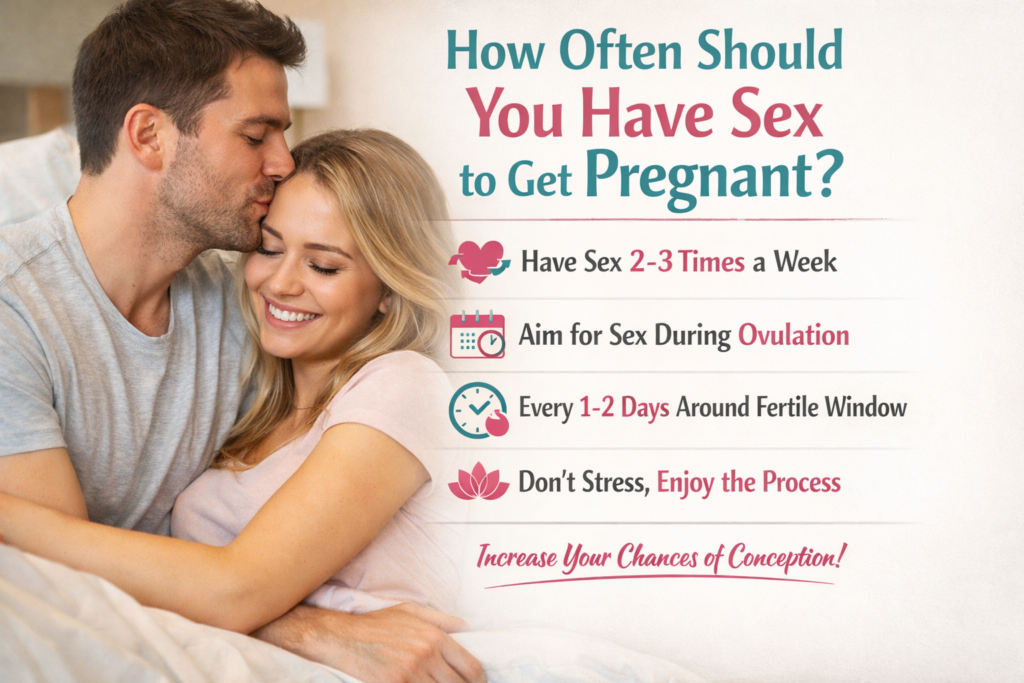
General Recommendation (No Ovulation Tracking)
If you’re not tracking ovulation closely:
Have sex every 2–3 days throughout the entire cycle.
Why this works:
- It ensures sperm are present when ovulation happens.
- It avoids stress of pinpoint timing.
- It maintains healthy sperm concentration.
This approach is widely recommended by fertility specialists because it covers the fertile window without pressure.
If You Are Tracking Ovulation
If you use ovulation predictor kits, basal body temperature, or cervical mucus tracking:
Have sex every day or every other day during your fertile window.
Ideal plan:
- Start 3–4 days before predicted ovulation.
- Continue through ovulation day.
Example:
If ovulation is expected on Day 14:
- Have sex on Days 10, 12, 13, 14 (or daily from Day 10–14).
This maximizes exposure of the egg to healthy sperm.
Is Daily Sex Better Than Every Other Day?
This is one of the most common fertility myths.
The Evidence:
Research shows that:
- Daily intercourse during the fertile window produces the highest pregnancy rates.
- However, every-other-day intercourse is nearly as effective.
For couples with normal sperm parameters, daily sex does not significantly reduce sperm count.
Sperm is produced continuously. In healthy men, daily ejaculation still maintains adequate sperm concentration for conception.
Does Frequent Sex Lower Sperm Count?
This depends on baseline sperm health.
In Men With Normal Sperm Count:
- Daily ejaculation slightly lowers sperm concentration.
- But total motile sperm count remains sufficient for pregnancy.
In Men With Low Sperm Count:
- Doctors may recommend intercourse every 36–48 hours.
- This allows sperm concentration to recover.
If there’s known male factor infertility, follow a healthcare provider’s guidance.
Is It Possible to Have Too Much Sex When Trying to Conceive?
Medically speaking, no — but practically, yes.
Excessive focus on frequency can lead to:
- Performance pressure
- Emotional strain
- Reduced libido
- Relationship tension
Conception is partly biological and partly psychological. Stress hormones like cortisol can indirectly affect reproductive hormones.
The goal is consistent, relaxed frequency — not mechanical scheduling.
What If You Only Have Sex Once During the Fertile Window?
Pregnancy can still happen.
Even one well-timed intercourse 1–2 days before ovulation can result in conception.
However, having intercourse multiple times during the fertile window increases statistical probability.
Think of it as improving odds, not creating guarantees.
What’s the Absolute Best Day to Have Sex?
The highest pregnancy rates occur when intercourse happens:
- 1–2 days before ovulation
- The day before ovulation is often considered optimal
Why?
Because sperm is already waiting in the fallopian tube when the egg is released.
Ovulation predictor kits detect the LH surge, which usually occurs 24–36 hours before ovulation — making that a prime time.
Should You “Save Up” Sperm?
Short answer: No.
Old advice suggested abstaining for several days to increase sperm count.
Modern research shows:
- Long abstinence (>5 days) can reduce sperm motility.
- Very frequent ejaculation (multiple times daily) may reduce concentration temporarily.
The ideal abstinence period for optimal sperm quality is typically 1–3 days.
This is why every-other-day intercourse works so well.
How Age Affects Sexual Frequency for Conception
Under 35:
Try for 12 months before seeking evaluation.
Over 35:
Try for 6 months before consulting a provider.
As female age increases, egg quantity and quality decline. Therefore, precise timing becomes more important.
How Often Should You Have Sex With Irregular Cycles?
If cycles are unpredictable:
- Have sex every 2–3 days continuously.
- Consider ovulation tracking methods.
Irregular ovulation can make pinpoint timing difficult, so consistent frequency becomes more important than exact prediction.
Does Position or Lying Down After Sex Matter?
There’s no strong scientific evidence that specific positions significantly increase pregnancy chances.
However:
- Lying down for 10–15 minutes after intercourse may help sperm remain near the cervix.
- Gravity does not significantly affect sperm’s ability to swim.
Sperm are fast and reach the fallopian tubes within minutes.
How Often Should Couples With Low Libido Have Sex?
Trying to conceive can reduce spontaneity.
If daily intercourse feels overwhelming:
- Focus on every other day during fertile window.
- Maintain intimacy outside fertility-focused sex.
- Communicate openly about pressure.
Emotional health is part of reproductive health.

What If You’re Doing Everything Right and Still Not Pregnant?
Even with perfect timing:
- The chance of conception per cycle is about 20–25% for healthy couples under 35.
- It may take several cycles.
Seek evaluation if:
- Under 35 and trying 12 months
- Over 35 and trying 6 months
- Known fertility conditions exist
- Irregular or absent ovulation
- History of reproductive disorders
Quick Summary: Ideal Sex Frequency for Pregnancy
If not tracking ovulation:
→ Every 2–3 days all cycle long
If tracking ovulation:
→ Daily or every other day during fertile window
If low sperm count:
→ Every 36–48 hours (doctor-guided)
Most important:
→ Consistency + low stress
Common Mistakes Couples Make
- Only having sex on ovulation day
- Waiting too long between attempts
- Stopping intercourse after positive ovulation test
- Over-stressing timing
- Ignoring male fertility factors
Conception works best when both partners optimize health and timing.
The Emotional Side of Timed Intercourse
Many couples report that scheduled sex feels clinical.
Helpful tips:
- Keep non-fertility intimacy alive.
- Plan date nights.
- Avoid discussing ovulation immediately before sex.
- Share responsibility for tracking.
Fertility is a shared journey, not one person’s burden.
Final Thoughts: Quality, Timing, and Consistency Matter Most
You don’t need marathon sessions or complicated schedules.
The science is clear:
Every 2–3 days works
Daily during fertile window is excellent
Stress reduction improves experience
Precision helps but perfection isn’t required
Pregnancy is a probability game — not a single-event outcome.
Stay consistent, stay informed, and give your body time.